
The Model Context Protocol is rapidly defining how AI agents connect to business systems. Here’s what it means for your integration strategy, your data, and your competitive position.
The Gap Between AI Promise and AI Performance
Most enterprise AI initiatives share a common trajectory. There is early enthusiasm, a successful proof of concept, and then a gradual realization that making AI deliver sustained business value is far harder than expected.
The reason is rarely the AI itself. Large language models are remarkably capable and continue to improve rapidly. The problem is what happens when those models need to interact with the real world of enterprise systems: your HRIS, your ERP, your CRM, your financial platforms, and the dozens of other applications your business depends on every day.
Connecting AI to these systems has required custom integration work for every combination of AI tool and data source. For an organization running ten AI-enabled tools across twenty business systems, this has meant building and maintaining potentially hundreds of individual connectors. Each with its own authentication logic, error handling, and ongoing maintenance requirements.
This is the “integration tax” that has quietly undermined enterprise AI return on investment, and it is exactly the problem that the Model Context Protocol was designed to solve.
What MCP Is and Why It Matters Now
The Model Context Protocol is an open standard that provides a universal method for AI systems to connect with external tools and data sources. Introduced by Anthropic in late 2024 and now governed by the Linux Foundation, MCP has been adopted by virtually every major technology company within its first year, including Microsoft, Google, Amazon Web Services, OpenAI, and Oracle, among many others.
The concept is straightforward. Before MCP, every AI application needed a bespoke connector for each system it needed to access. If you had N AI tools and M data sources, you needed N×M integrations. MCP reduces this to N+M. Each AI tool implements the protocol once. Each data source implements it once. They all speak the same language.
The analogy that resonates with most leaders is USB. Before USB, every peripheral device required its own proprietary cable and port. USB established a single standard, and the entire hardware ecosystem simplified overnight. MCP is doing the same thing for AI connectivity, and the implications for enterprise architecture are significant.
The NxM Problem, Visualized
To make this concrete, consider a company with three AI agents and five product APIs. Without MCP, every agent needs a custom integration to every API – 15 individual connections, each with its own authentication, data formatting, and error handling.

Figure 1: Without MCP: 3 agents x 5 APIs. Every line is a connector to build and maintain.
With MCP, each agent connects to the protocol once, and each API exposes itself once. Fifteen integrations become eight connections.
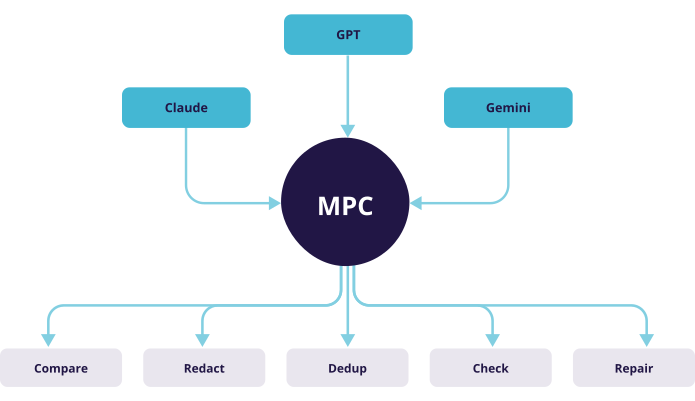
Figure 2: With MCP: 3 agent connections + 5 tool registrations = 8 total. The MCP server’s hub.
The savings grow multiplicatively. Ten agents and twenty data sources? That is 200 custom integrations reduced to 30. This is not an incremental improvement; it’s a structural change in the economics of AI integration.
The Strategic Case for Paying Attention to MCP
As organizations mature their automation efforts, data governance tends to fall into two complementary disciplines: corrective and preventative.
Corrective governance focuses on identifying and addressing issues as they emerge. This includes monitoring key data quality metrics, investigating anomalies, and resolving discrepancies between systems. It may involve readiness scoring before major releases or automation rollouts. It often includes human review in high-stakes workflows, ensuring that sensitive or financially material decisions receive oversight.
Preventative governance looks upstream. It embeds validation rules at points of entry. It standardizes formats and definitions before data propagates downstream. It designs architectural safeguards that isolate sensitive information and enforce access boundaries. It builds processes that prevent drift rather than simply correcting it.
When these two disciplines work together, the effort required to manage data decreases over time.
Tooling That Supports Data Governance at Scale
For senior leaders evaluating technology investments, MCP is not a technical curiosity. It is a structural shift in the economics and feasibility of enterprise AI. There are four dimensions worth examining.
- Accelerated Time to Value: The primary bottleneck in most enterprise AI projects is no longer model selection or prompt engineering; it is integration. MCP dramatically reduces the time and cost required to connect AI capabilities to the systems where your data lives. Projects that were previously measured in quarters can be live in weeks.
- A Fundamentally Different Cost Structure: Integration complexity has historically been the primary driver of enterprise AI project costs. When the number of required integrations drops from N×M to N+M, the financial model for AI initiatives changes substantially. Use cases that were not economically viable become achievable. A scope that was prohibitively expensive becomes manageable.
- Architecture That Adapts: Standards create durability. Organizations that build their AI integration approach around MCP position themselves to adopt new AI capabilities as they emerge, without having to rebuild their connectivity layer each time. In a landscape where AI models and tools evolve rapidly, this flexibility is a strategic asset.
- Competitive Differentiation: In industries where AI-driven efficiency and insight create meaningful competitive advantages, including financial services, retail, healthcare, and professional services, the organizations that can deploy AI faster and more broadly across their operations will establish measurable leads. MCP is becoming the foundational infrastructure for that capability.
Where MCP Creates Immediate Enterprise Value
The protocol is particularly transformative in business functions where data spans multiple systems and decisions require real-time context.
Human Resources and Workforce Management
AI agents with standardized access to HRIS, payroll, benefits, and performance management systems can deliver genuinely useful support across the employee lifecycle. Consider intelligent onboarding assistants that understand a new hire’s role, location, and department, then orchestrate the correct sequence of system access, equipment provisioning, and compliance steps, handling variations automatically rather than following rigid scripts.
Finance and Accounting
When AI has governed access to financial systems, ERP platforms, and reporting tools, it can identify anomalies, generate insights, and support decision-making with speed and consistency that manual processes cannot match. The key requirement is real-time access to accurate, governed data, which is precisely what MCP enables.
Operations and Supply Chain
Multi-system visibility has always been the aspiration in operations management. MCP allows AI to work across inventory management, logistics platforms, supplier systems, and demand forecasting tools simultaneously, creating the kind of unified operational intelligence that leaders have pursued for years.
Customer Experience
AI agents that can access customer history, account details, order status, and support records in a single interaction can resolve issues meaningfully, rather than simply escalating them. MCP makes this system’s access both manageable and secure.
From Theory to Practice: Building an MCP Server for Data Processing
At Dispatch, we built an MCP server that exposes our entire data processing suite – Compare, Redact, Dedup, Check and Repair to any MCP-compatible AI agent. Here is what we learned:
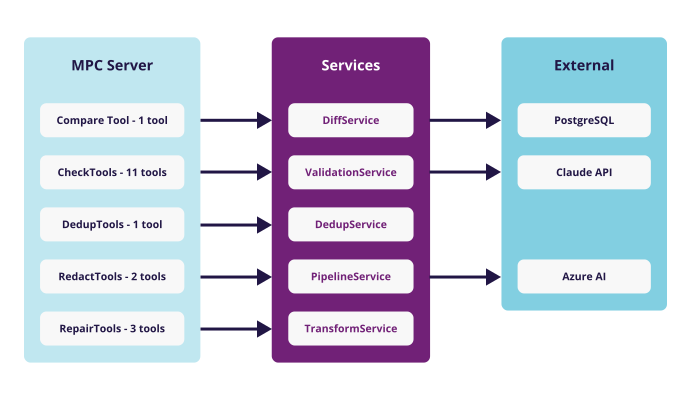
Image 3: The architecture: an AI agent connects once via HTTP + SSE. The MCP server routes tool calls to shared services – the same services that power the REST API and web UI.
The problem: Five Products, One Integration Surface
Dispatch ships five data processing APIs. Each one has its own endpoints, authentication, request/response formats, and file handling. Without MCP, any AI agent that wanted to use our tools would need five separate integrations – and so would every other agent. That is the NxM problem in practice.
The Solution: 18 tools, one endpoint
Our MCP server exposes 18 tools across 5 product areas via the/mcp endpoint. An AI agent connects once and gets access to everything: comparing datasets, redacting PII from documents, deduplicating records, validating data quality, and transforming columns.
An Ecosystem in Rapid Motion
The pace of enterprise adoption has been notable. Leading iPaaS providers have built MCP directly into their platforms, delivering fully managed and governed MCP server capabilities that connect AI agents to thousands of enterprise applications with the identity management, access controls, and audit trails that production deployments demand.
This is a critical development. While there are thousands of open-source MCP servers available, enterprise deployments require more than raw connectivity. They require the security, governance, and reliability infrastructure that organizations depend on for mission-critical processes. The maturation of enterprise-grade MCP tooling signals that the protocol has moved beyond experimentation.
Major enterprise software vendors, including Workday, Salesforce, SAP, NetSuite, and ServiceNow, are providing or developing MCP-native access to their platforms. For organizations already invested in these systems, MCP represents a path to AI-enabling their existing infrastructure without replacing it.
Governance Is Not Optional
Any conversation about giving AI agents access to enterprise systems must address security and governance directly. Governing N+M integrations with MCP is possible, and we would argue that governing NxM integrations without MCP is impossible. Furthermore, MCP includes specifications for authentication, authorization, and consent controls. AI tools must request explicit permission before accessing data or executing actions. Organizations can implement granular policies governing what AI can see and do.
However, the security of any MCP implementation depends entirely on how it is deployed. Research in 2025 identified thousands of MCP servers operating without proper authentication, a sobering reminder that protocols and standards are only as effective as their implementation.
This is where implementation expertise matters most. The difference between an MCP deployment that creates lasting value and one that creates risk comes down to how thoughtfully the security model, access controls, and monitoring infrastructure are designed, and how rigorously they are maintained over time. This is just one advantage of choosing an enterprise-grade MCP platform such as that offered by Dispatch’s partner, Workato.
Turning MCP Into a Strategic Asset
MCP represents a fundamental shift in how enterprises connect AI to their systems, but realizing its full value requires more than adoption. It requires architectural clarity, disciplined governance, and an integration strategy designed for constant change.
Enterprises that approach MCP with this mindset will move faster, deploy AI more broadly, and avoid the integration debt that has limited previous generations of enterprise AI.
Dispatch helps organizations translate MCP from an emerging protocol into a resilient enterprise capability, designing the integration, security, and operational foundations needed to support AI at scale.

Anes Berbić
Anes Berbić is a Junior Application Developer at Dispatch Integration, a data integration and workflow automation company serving clients globally. He specializes in building and optimizing technical solutions that streamline complex data workflows and enhance operational efficiency.