
We are in the middle of a seismic shift in the enterprise software landscape, unlike anything we’ve seen since the advent of cloud computing. Vibe coding is moving from being a novelty to quickly becoming the norm. Gartner estimates that by 2028, 40% of enterprise application development will involve AI-generated code. GitHub data already shows that over 46% of code in many repositories is now AI-assisted, and Google just announced that 75% of its code is now AI-generated.
This is democratizing software development. The era of developers being mystical creatures who could do things impossible for mere mortals is over. The era of the citizen developer is here.
For many organizations, this feels like liberation. And in many ways, it is.
But at Dispatch Integration, we’ve been sitting with a more nuanced question: what happens after the liberation?
The Power of AI Innovation and the Growing Risk of Unmanaged Applications
The ability to go from idea to working prototype in hours, not weeks, is a genuine breakthrough for business innovation. Domain experts who have spent years knowing exactly what a tool should do, but couldn’t build it, can now build it. That’s a profound and exciting shift. I know that firsthand –I vibe-coded two apps over the weekend that I wanted for years. It’s true that when I showed them to my technical co-founder, he looked at me like a parent might look at a child who just brought home a piece of artwork made with macaroni. But they worked, and I was proud of them. And then he asked me two questions: 1) Are they secure? And 2) who is going to manage them?
The same forces driving this exciting acceleration are also creating a new category of enterprise risk that I don’t think many organizations are honestly reckoning with.
Imagine it’s eighteen months from now. Your organization has leaned fully into AI-accelerated citizen development. Dozens of teams and hundreds of people (perhaps even your CEO) have been trained to vibe code. They have access to your data, your APIs, and your AI infrastructure. And they’ve built things. Lots of things. Applications that automate workflows, surface insights, assist customers, and support decision-making. You are now living in the year 3000.
And then you try to answer these questions:
- How many of these applications are running right now?
- Which ones are accessing sensitive data?
- Which ones are making autonomous decisions that affect customers or compliance?
- What happens when the person who built the app leaves?
- What’s the total monthly spend on tokens across all of them?
- If one of them produces a harmful hallucination, do you even know it happened?
If you can’t answer these questions (and you won’t be alone), you don’t have a portfolio of innovations. You have a portfolio of unmanaged risks.
This is the challenge we’ve been wrestling with at Dispatch, and it’s exactly what brought our DELIVER methodology back to the center of our thinking.
How DELIVER Powers Enterprise AI Development and Governance
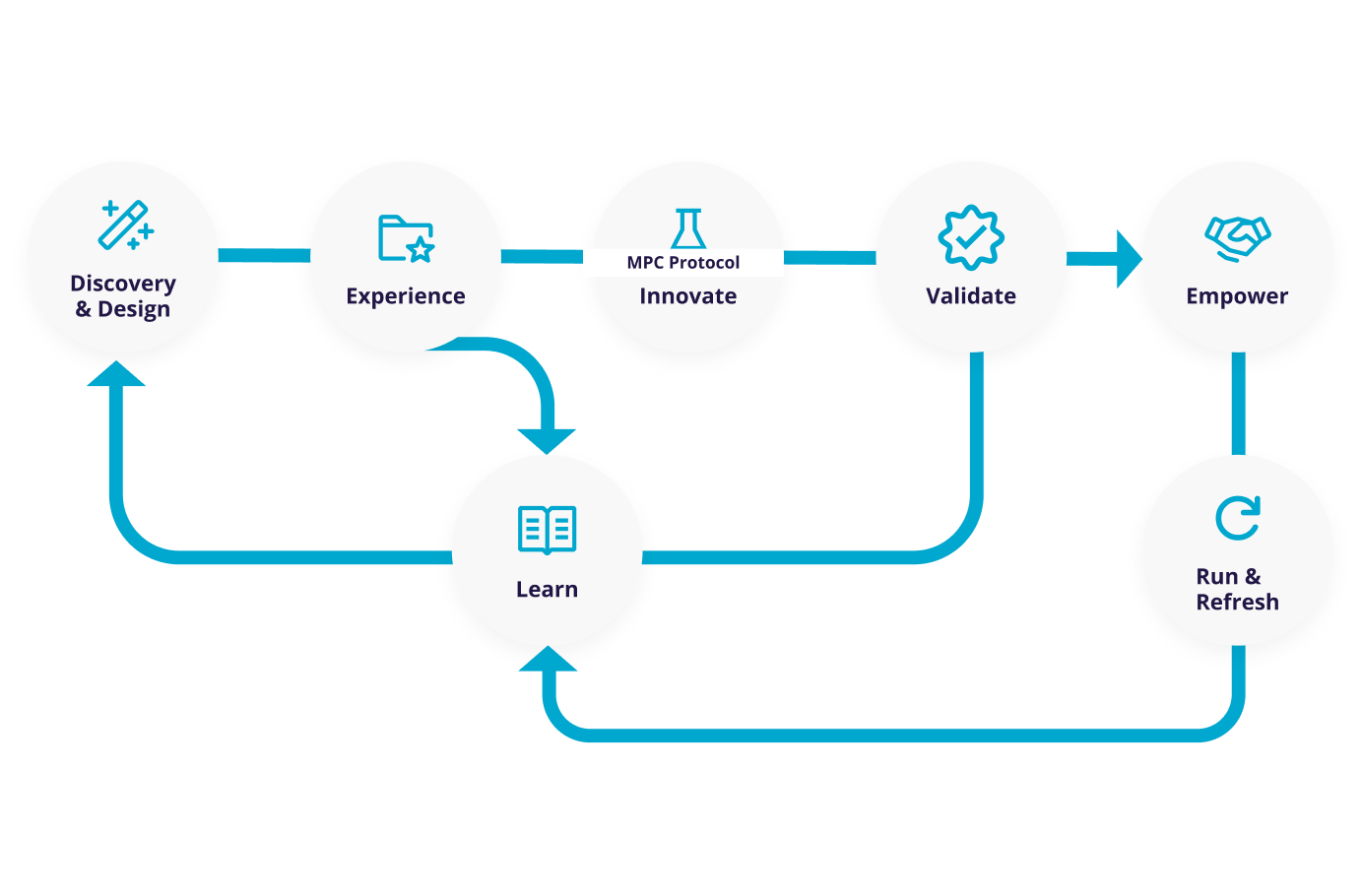
We’ve leveraged three core methodologies at Dispatch Integration. DEEP helps organizations develop digital transformation strategies with clear ROI. DIVE is our proven execution framework for integration, automation, and orchestration. And DELIVER –Design, Experience, Learn, Innovate, Validate, Empower, Run & Renew —is how we build integrated enterprise applications that have a human-experience or agentic AI layer.
What we believe, with increasing conviction, is that vibe coding doesn’t make DELIVER less relevant. It makes the back half of DELIVER more critical than ever — while transforming the front half in ways that are genuinely exciting.
Let me explain…
The Front Half: Where Vibe Coding Changes Everything
The DEL of DELIVER — Design, Experience, Learn — has historically been the part where front-end designers, product managers, and front-end developers get involved. Because these people don’t know the business requirements or the application’s context, there tend to be lots of meetings, interviews, and expensive back-and-forth just to explain the basics. Then, wireframes take time. Prototypes take sprints. Documents are generated and iterated. The cycle of design-feedback-redesign-feedback has been the graveyard of many great ideas that never got far enough to test whether they were actually great.
Vibe coding collapses this cycle.
Working prototypes can now be built in hours by the people who actually understand the job to be done. The DEL loop — designing, experiencing, learning, and iterating through those cycles becomes almost frictionless. Business users can see a working version of their idea on day one. They can react to something real, not hypothetical. They can discover, within days, whether the idea solves the actual problem or just a hypothetical version of it.
This is genuinely game-changing for innovation. Research on rapid prototyping has consistently shown that the number of iteration cycles, not the quality of the first attempt, predicts the quality of the final outcome. Vibe coding doesn’t just speed up iteration — it makes iteration cheap enough to do as many times as you need.
So yes: embrace this. Train your people. Encourage experimentation. The DEL half of DELIVER has never been more powerful.
But if you stop there, you’ve created a prototype factory — not an innovation engine.
The Back Half: Where Enterprises Win or Lose
This is where I want to spend more time, because it’s where I see the greatest gap between what organizations are planning and what they actually need.
The IVER of DELIVER – Innovate, Validate, Empower, Run & Renew – is the difference between a vibe-coded prototype and a scalable, secure, enterprise-grade solution that continues to generate value long after the person who built it has moved on.
Innovate: Moving AI Prototypes to Production Ready Enterprise Applications
Innovating, in our framework, isn’t just about building new things. It’s about the deliberate work of moving a rapid prototype from “it works on my machine” to “it works safely, securely, and sustainably in our environment at scale.”
This is where architectural decisions get made. Which AI model is actually appropriate for this use case, and is it the cheapest one that meets the requirements, or just the first one tried? How does this application integrate with enterprise systems in a way that’s observable and governable? Does it belong in an enterprise MCP framework like the kind Workato has been developing, which gives the organization visibility and control over what AI agents are doing on its behalf? Is data access appropriate and secure for all use cases and user roles? And will poor data quality undermine the value by causing failures at machine speed?
The innovate phase is also where resilience gets built in. Vibe-coded prototypes are often brittle in ways their creators don’t realize, because the happy path works beautifully and no one has thought hard about what happens when it doesn’t. What are the failure modes? How does the application behave when an upstream API is slow, a model returns unexpected results, or a user does something the builder never anticipated?
These aren’t glamorous questions. But they are the questions that determine whether an application has a future.
Validate: Testing What Actually Matters
Here’s something we’ve noticed consistently in vibe-coded applications: the requirements are implicit. They live in the builder’s head, shaped by their experience and manifested in the iterative process of prompting and responding. But they were never written down, never shared, and never reviewed. The application does what its creator expected, but that’s not the same as doing what the business needs it to do.
Validation in the context of AI applications is also more complex than traditional software testing, because the failure modes are different. You’re not just testing for bugs. You’re testing for hallucinations – for cases where the application confidently produces wrong answers. You’re testing for edge cases that the builder never considered. You’re testing for bias, for fairness, for regulatory compliance, depending on the domain.
And crucially, you’re testing in ways that reflect what real business failure looks like. What is the cost of a wrong answer in this application? Is it a minor inconvenience, or does it expose the organization to legal liability? That risk assessment should shape how much validation effort is warranted, but it requires someone to actually think this through.
Empower: Turning “Cam’s App” into a Scalable Business Asset
Empower is the most underappreciated phase in the entire methodology.
An application that exists in one person’s head — that only that person can maintain, update, or explain is not a company asset. It’s a liability with a timer. The moment that person changes roles, takes a vacation, or leaves the organization, you have a problem.
The empower phase is about transferring ownership from an individual to the organization. It includes the obvious things: documentation, code repositories, and access controls. But it’s also about change management — ensuring that the people who will use this application actually want to use it, understand how to use it, and know what to do when something goes wrong.
It’s about training. Not just “here’s how to use the app” training, but “here’s what this app is doing, here’s what it’s connected to, here’s how it makes decisions” training. Transparency about how AI-assisted applications work isn’t just nice to have — it’s increasingly a regulatory expectation in many domains.
Run and Renew: Managing the AI Application Lifecycle for Long Term Value
The final phase is about sustainability — in the broadest sense of that word.
Running an AI application isn’t like running traditional software. Models change. The context in which an application operates changes. What was a high-ROI use case eighteen months ago might be table stakes today, or better handled by a more recent capability. Responsible application lifecycle management means regularly asking: Is this application still earning its place?
Run & Renew is about governance — audit trails, usage monitoring, and cost management. An application consuming tokens at scale that no one is monitoring is a budget risk. An application making decisions that no one is auditing is a compliance risk. The Run & Renew phase is where those risks get managed.
And yes, it includes retirement. One of the healthiest things an organization can do with its portfolio of AI applications is regularly decommission the ones that have outlived their value. That’s not failure. That’s mature portfolio management.
The Full AI Application Journey From Idea to Enterprise Value
Here’s the formulation I keep coming back to: the definition of Innovation is “profitable invention”.
So you need to think beyond the moment of invention. Not just the moment of creation. The full arc from idea to sustained value creation.
Vibe coding has made the invention part easier and faster, and more accessible than it has ever been. That is genuinely wonderful. But it hasn’t changed what makes invention profitable, which is the disciplined work of moving from a promising idea to a solution that works reliably, at scale, in the real conditions of an organization, over time.
What we’re hearing from clients is a version of this: “We’re very excited about AI, and we’ve given our teams tools to experiment, and now we have a lot of experiments, and we’re not sure what to do next.”
What they’re experiencing is the gap between DEL and IVER.
The organizations that will win in this environment aren’t the ones that generate the most prototypes. They’re the ones that build the organizational capability to move the best prototypes all the way to the right — through Innovate, Validate, Empower, and Run & Renew — and that have the governance infrastructure to know which ones deserve that journey.
AI is present in every phase of DELIVER. It accelerates design and prototyping, assists with testing and validation, and supports ongoing management. We’re not arguing for a return to slow, bureaucratic development processes. We’re arguing for a methodology that is both fast and responsible — that harnesses what’s genuinely new about this moment without ignoring what has always been true about building technology that lasts.
The vibe is important. But the methodology is what turns the vibe into value.
Dispatch Integration works with enterprise organizations to navigate digital transformation through three proven methodologies: DEEP, DIVE, and DELIVER. If you’re thinking about how to build an integrated AI application portfolio that’s both innovative and sustainable, we’d welcome the conversation.

Cameron Hay is the CEO of Dispatch Integration, a data integration and workflow automation company with clients in Canada, US, Europe and Australia. He has over 30 years of leadership experience in various technology-oriented industries.


